
Type de profil et informations techniques
Halle Lux sheets are made in the same profile shapes as profiled steel sheet, aluminium sheet and fibre cement sheets.
We have profile tools for almost all Nordic manufacturers’ profiles as well as many other European profiles. New profile tools can be produced quickly and cost-effectively.
A major advantage of Halle Lux sheets is that they can directly end-overlap and side-overlap steel and aluminium profiles, without costly joint flashing or connecting sheets.
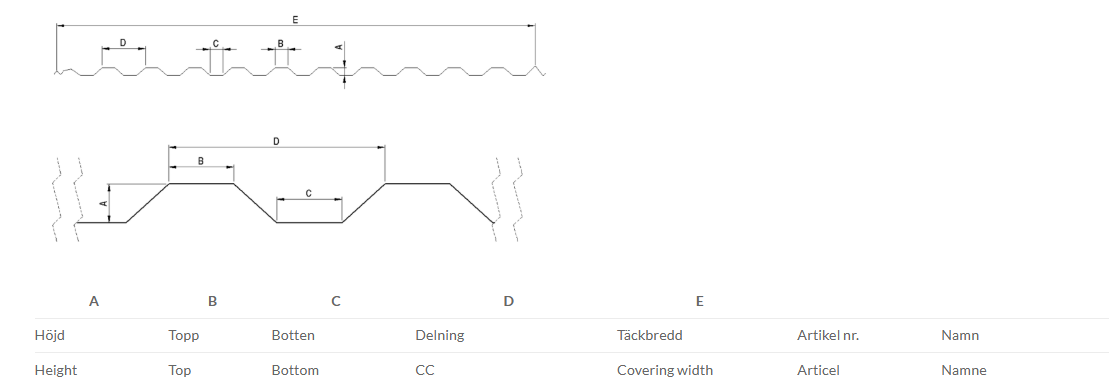
Mesure du profil
Le profil se mesure par la hauteur, le haut, le bas, le pas et la largeur utile, comme indiqué sur la figure.
Walkability – fall-through
Walkability is defined in SIS 271113 as the ability, during careful walking by a person weighing 100 kg, not to create permanent deformation greater than 3 mm or dents. This applies for the tested support arrangement and span.
Walkability is not a requirement in any Nordic building code, but only applies if Hus AMA 83 N 5,11 is referenced in Sweden.
Halle Lux sheets should normally not be walked on. Installation is carried out from the side, from a roof ladder or from a load-distributing board. Walking should only occur in exceptional cases, over supports and when the sheets are fixed. If walking is necessary, always step on at least two wave tops or in the profile bottom.
Fall-through protection
Halle Lux sheets with 900 g/m² reinforcement have been tested and meet the requirements according to the Swedish National Testing and Research Institute procedure SP method 0487, Fall-through protection.
Halle’s general recommendation is that Halle Lux and Halle Dur sheets should not be walked on. Use special work platforms, a roof ladder or a load-distributing board.
Temperature influence
The coefficient of linear expansion for Halle Lux is 20–25 x 10⁻⁶. This gives about 1 mm per metre of sheet at a temperature difference of 40 °C. It is roughly the same expansion as aluminium and about twice that of steel.
Other plastics, for example PVC and polycarbonate, have three to four times greater expansion than Halle Lux sheets.
The highest temperature Halle Lux sheets without load may be exposed to is +120 °C. The lowest recommended service temperature is –40 °C. Halle Lux sheets do not become brittle at low temperature, unlike some unreinforced plastics such as PVC.
Tests have shown that Halle Lux works as a load-bearing sheet even at the high temperatures, about 80 °C, that can occur in overlaps between metal and plastic. The heat distortion temperature of the polyester is about 75 °C. These values apply to ortho- and isopolyesters. Vinyl esters, such as Derakane®, can withstand higher temperatures.
Due to temperature movement, sheet length should normally not exceed 8 metres. For greater lengths, sliding end overlaps are used. The maximum sheet length that can be manufactured is 12 metres, but transport of sheets this long can be difficult.
Curved roof installation
Halle Lux sheets have been used for many years on different types of curved roofs. The sheets are supplied as standard and bent to the correct radius over the rails during installation.
The spacing between rails in an arched hall may be 75 % of the span for the three-span case with flat-laid Halle Lux sheets. At least three spans are required in curved form. This applies to 450 g reinforcement and 20 profiles with a minimum radius of 5 metres, and 45 profiles with a minimum radius of 10 metres.
For good sealing in the side overlap, profiles with overlap of both profile bottom and profile top should preferably be selected. Symmetrical profiles are also recommended, meaning profiles where top and bottom are equally sized.
When calculating fasteners along the rails, note that bending adds an additional force beyond wind load: F = E x I/(R x L). R is the curve radius, L is the distance between rails and EI values are shown in the table.
For Halle Lux/Halle Lux end overlaps, the force on fasteners is 2 x F, one F from each sheet. If Halle Lux/metal overlap is used, the metal sheet’s EI value must be used to calculate one of the F forces. We recommend fastening in the profile bottom.
Ask Halle which minimum radii and EI values apply for other profiles and reinforcement weights.
| Profile height | Value |
|---|---|
| 20 | 0.57 |
| 45 | 2.63 |
Thermal insulation – condensation
Heat can be transferred in three main ways: radiation, conduction and convection. The insulating effect of single or double Halle Lux sheets is affected only marginally by radiation. Radiation is, however, important for the greenhouse effect.
Thermal resistance from conduction is RL = d/λ = 0.001/0.15 = 0.007 m² x °K/W. Thermal resistance from convection is Rk = 0.2 m² x °K/W. The Up value becomes 1/(0.007 + 0.2) = 4.83 W/m² x °K. If conduction resistance is ignored completely, Up = 5.0 W/m² x °K.
The insulating effect of single and double Halle Lux sheets depends almost entirely on convection. This means that the insulating effect of a profiled sheet is at least as good as that of a flat sheet. With double Halle Lux sheets, an insulating air gap is created and the U-value is about 2.8 W/m² x °K.
Halle Lux sheets can be protected against condensation by applying KONISOL anti-condensation protection, nylon fibres bonded with a non-yellowing adhesive, just as for metal sheet.
Condensation is water precipitation that occurs when water vapour in air becomes liquid. It can be caused by falling air temperature, humid air meeting a cold surface or poor ventilation.
Common condensation cases occur during snowmelt when snow remains on the roof, in grey weather during autumn and spring and on cloudless nights. The location and design of a building strongly affect condensation risk. Proximity to water and poor ventilation increase the risk.
In general, condensation occurs less often on plastic sheets than on metal sheet because plastic sheet temperature does not fall as much as metal sheet temperature on cloudless nights. Increased ventilation also reduces condensation risk. For patios and carports, any condensation normally disappears quickly when weather conditions change.
| Construction | U-value |
|---|---|
| Single Halle Lux sheet | 5.5 W/m² x °K |
| Double Halle Lux sheets | 2.8 W/m² x °K |
Cutting, handling and storage
Halle Lux is a lightweight material, so care is needed during unloading and transport on site so the sheets are not caught by the wind. Impacts and knocks should be avoided, as white impact marks may occur.
During storage, the material must always be secured so it cannot be lifted by the wind. Long sheets can suitably be transported by rolling individual sheets and carrying them every three metres.
Storage should be in slightly sloping bundles, maximum 1 metre high, with support every metre. For outdoor storage, sheets must always be protected from rain, for example with tarpaulins. Water between sheets can, during longer storage and especially in heat, cause discolouration and some release of surface films. Store dry and ensure air circulation between sheets.
Halle Lux sheets can be worked with ordinary carpentry tools. When cutting by hand, hold the fine-toothed saw at a slight angle to the sheet. Use backing on the top and underside to make cutting easier.
Side and end overlaps
For roofs, one-wave side overlap is usually used, one full profile bottom and one full profile top, alternatively half a wave with support foot. The latter overlap type should be sealed regardless of roof pitch. For walls, an overlap of only one profile top or one profile bottom is normally sufficient.
For sheets with 450 g reinforcement, standard roof rivets are recommended. Special rivets are recommended for sheets with 750 and 900 g reinforcement and are only placed where two sheets overlap, not in four-sheet intersections. When sealant is used, rivets are placed at 300 mm centres; otherwise 500 mm centres. Riveting is often not used when rail spacing is less than 1000 mm.
The coefficients of linear expansion for Halle Lux and aluminium sheet are approximately equal, while steel sheet has about half the coefficient. To avoid temperature stresses, riveting in the Halle Lux/profiled metal side overlap is recommended only in the middle 5 metres.
End overlap between two sheets can be fixed, meaning the fastener is drawn through both sheets. This can be used up to a continuous sheet length of 8 metres. For lengths above 8 metres, sliding end overlap is used, either by placing the fastener about 20 mm above the end of the lower sheet or by making an elongated hole in the lower sheet.
Sliding end overlaps are always sealed with two beads of sealant below the screw row. Silicone is recommended. Fixed end overlaps are normally sealed at roof pitches below 14 degrees. Under special exposure, sealing should also be used at steeper pitches. Overlap length should be at least 200 mm on roofs and 100 mm on walls.
To reduce the number of end overlaps, full-length Halle Lux sheets are recommended. Silicone is recommended as sealant because it fills the joint well and remains elastic. For some profiles, screws may need to be placed more closely to achieve fully satisfactory sealing.
Tolerances
Length tolerance for Halle Lux sheets is –5/+25 mm. Profile dimensions in the profile programme are approximate, because curing of the plastic during manufacture can produce slight differences in plan dimensions.
Small ribs, especially with 900 g reinforcement, cannot be made as distinct as when roll-forming metal sheet, for example water locks used by many sheet manufacturers. In some cases it is more advantageous to use the corresponding profile without water lock, or to cut away the water lock on the plastic profile at the end overlap.
Durability
Polyesters have considerable resistance to acids and acidic environments. Polyester also has high resistance in alkaline environments. Isopolyester has greater resistance than orthopolyester. Various vinyl esters, such as Dion®, have the greatest resistance.
Halle Lux is resistant to microorganisms, fungus, larvae, mould and insects.